
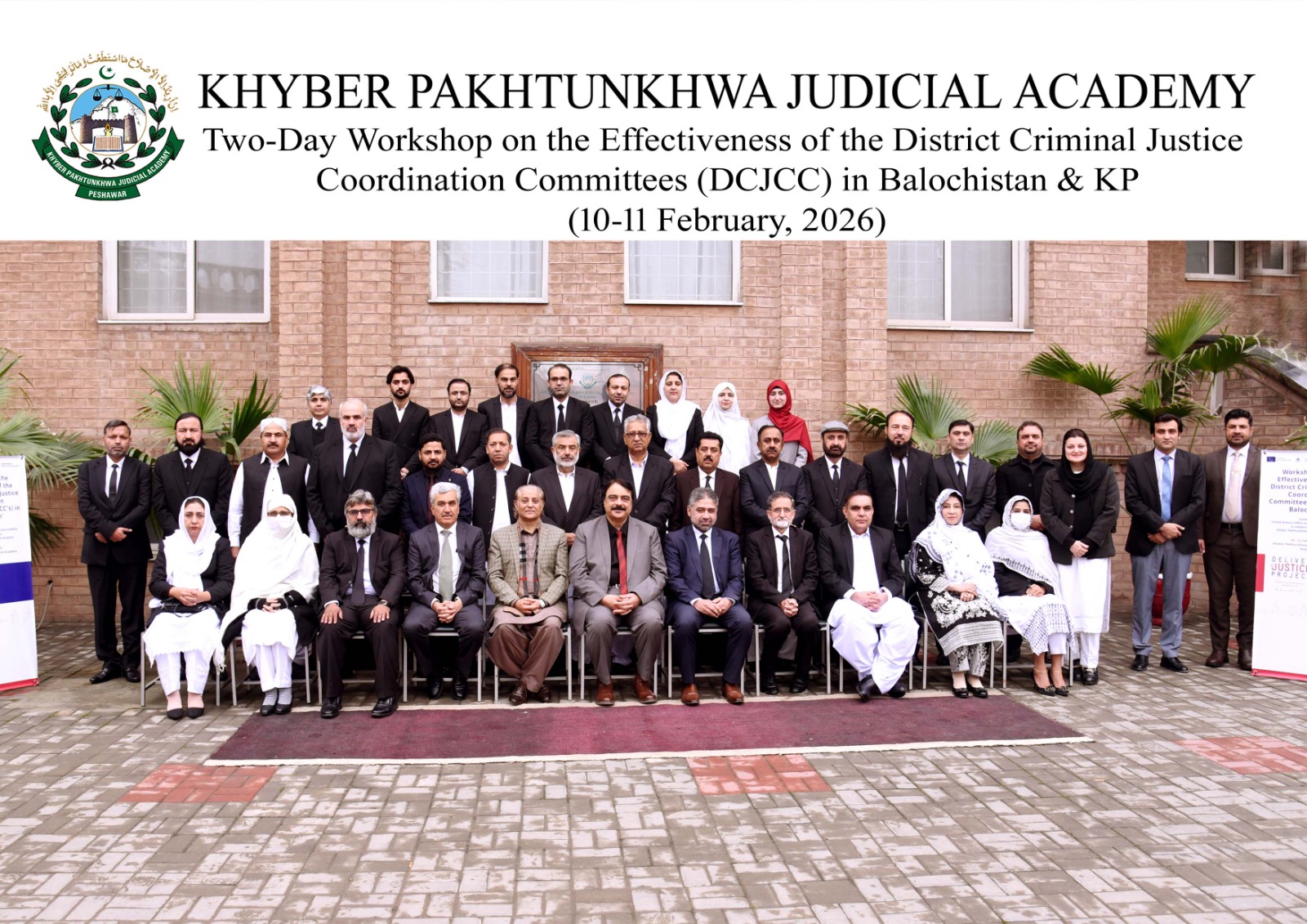
Peshawar:UNODC, under the European Union-funded Deliver Justice Project, in collaboration with the Khyber Pakhtunkhwa (KP) Judicial Academy, organized a two-day workshop on 11 and 12 February, 2026 aimed at strengthening the effectiveness of District Criminal Justice Coordination Committees (DCJCCs) in Balochistan.
The workshop brought together members of the judiciary from Balochistan and KP, along with justice sector stakeholders and experts from the KP Judicial Academy. The initiative provided a platform for cross-provincial learning, experience-sharing, and practical dialogue to enhance coordination across the criminal justice system.
Strengthening Justice Sector Coordination
District Criminal Justice Coordination Committees play a vital role in promoting coordination among police, prosecution, judiciary, prisons, and probation services at the district level. The workshop opened with remarks from senior representatives of the Balochistan High Court, UNODC, and the KP Judicial Academy, emphasizing the importance of structured inter-agency coordination to improve justice delivery and uphold the rule of law.
Discussions on Day 1 focused on the mandate and role of DCJCCs under the Rule of Law Roadmap, stakeholder reflections on key challenges, and a detailed presentation on best practices from Khyber Pakhtunkhwa. Ms. Sofia Waqar Khattak, District & Sessions Judge, Kohat, shared insights into the functioning of DCJCCs in KP, highlighting successful approaches, institutional mechanisms, and lessons learned.
Participants also conducted a stocktake of the current status of DCJCCs in Balochistan, identifying strengths, gaps, and areas requiring further support.
From Dialogue to Action
Day 2 centered on identifying operational, structural, and resource-related challenges affecting DCJCCs in Balochistan. Through breakout group discussions and plenary exchanges, participants developed practical, context-specific recommendations to enhance effectiveness.
Key recommendations included ensuring regular and structured DCJCC meetings, strengthening follow-up mechanisms, improving data-sharing among institutions, enhancing institutional ownership, and identifying capacity-building needs.
Participants presented their consolidated recommendations during the action-planning session, reaffirming their commitment to improved inter-agency collaboration. The class representative delivered remarks on behalf of the participants, expressing appreciation for the opportunity to engage in meaningful dialogue and peer learning.
Closing and Way Forward
The workshop concluded with Director General Jehanzeb Shinwari distributing certificates to participants in recognition of their active engagement and contributions.
The event closed with renewed commitments from stakeholders to implement the agreed recommendations and further institutionalize the role of DCJCCs in strengthening coordinated justice delivery across Balochistan.
Through this initiative, UNODC and its partners continue to support sustainable reforms that enhance cooperation, efficiency, and accountability within Pakistan’s criminal justice system.