
KPJA CONCLUDES LANDMARK 5-DAY TRAINING ON FOUNDATIONAL IT SKILLS AND AI CORE COMPETENCIES FOR JUDICIAL OFFICERS (19 TO 23 OCTOBER, 2026)
PESHAWAR: The Khyber Pakhtunkhwa Judicial Academy (KPJA), Peshawar, successfully conducted a specialized five-day training program titled “Foundational IT Skills and AI Core Competencies for Judicial Officers" from October 19 to 23, 2026. Designed to align institutional capacity with the *National Guidelines for Use of Artificial Intelligence in Judicial Institutions of Pakistan* approved by the National Judicial (Policy Making) Committee, the course equipped participating judges with practical digital skills, ethical guidelines, and AI workflows to modernize court administration while safeguarding human oversight and judicial independence.
A selected cohort of 23 judicial officers, comprising 10 Additional District & Sessions Judges / Izafi Zilla Qazis and 13 Civil Judges / Judicial Magistrates/ Ilaqa Qazis representing districts across the province—participated in this intensive, hands-on training.
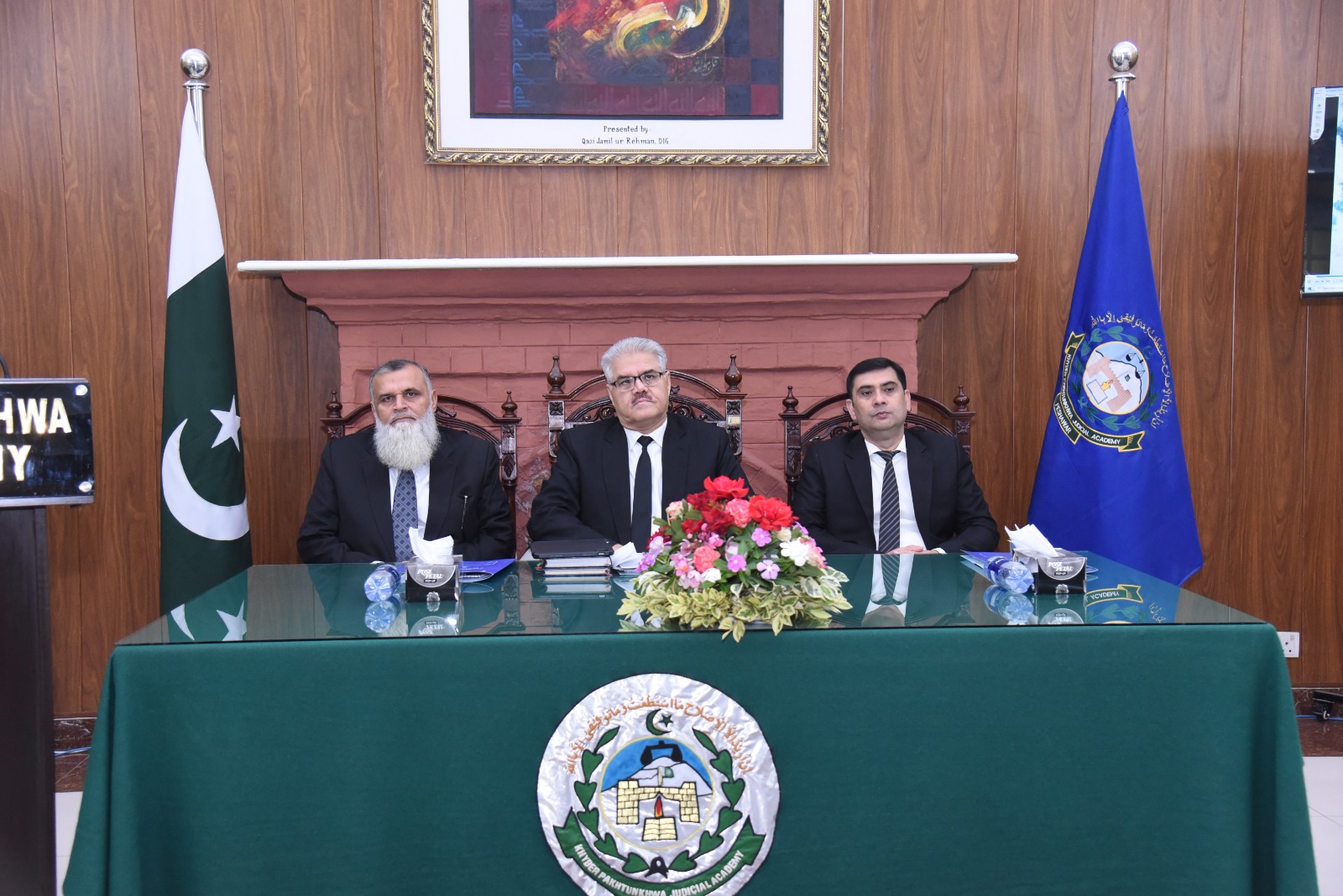
The training formally commenced with an inaugural ceremony chaired by the Hon’ble Chief Justice, Peshawar High Court, Mr. Justice S.M. Attique Shah, who attended as Chief Guest. In his address, the Hon’ble Chief Justice underscored the vital necessity of technological literacy, responsible AI integration, and digital proficiency in modernizing judicial workflows and reducing case backlogs. Earlier, Director General, Mr. Kalim Arshad Khan, delivered the welcome address, reaffirming the Academy's strategic resolve to build technological competencies across the judicial hierarchy. The inaugural session was attended by all senior officers and faculty members of the Academy.
The course curriculum was designed through consultative collaboration with leading academic institutions, including IM Sciences, CUSIT, and FAST-NUCES, ensuring a structured tool-by-tool approach with individual lab workstations:
Mr. Ahmed Iftikhar, Dean Faculty KPJA, introduced fundamental AI concepts, distinguishing generative, agentic, and predictive AI models from standard search engines. Subsequently, Mr. Dost Mohammad Khan, Director Instructions, led basic and advanced MS Word laboratory sessions focusing on document formatting, headers, sections, automated tables of contents, and track changes essential for judicial drafting.
Conducted by Dr. Omer Usman (Director IT Department / Faculty Member, FAST University, Peshawar), participants explored the Gemini platform, MS Word integration, speech-to-text dictation (OpenAI Whisper / Omnilingual ASR), and privacy-preserving local offline LLMs (LM Studio / Ollama). Judicial officers built practical AI agent scenarios, including document redaction pipelines, trial record chronology extractors, and case law citation auditors.
Led by Dr. Arif Shah (Dean Faculty, CUSIT, Peshawar), sessions focused on ChatGPT model families (reasoning vs. fast models), privacy configurations (Temporary Chat, model-improvement settings), and structured prompt engineering. Officers performed source-grounded document analysis with exact page citations and quotes, refined drafts on Canvas, and transformed spreadsheets into visual data charts.
Facilitated by Prof. Dr. Awais Adnan (IM Sciences, Peshawar), judicial officers engaged in Claude interface navigation, thinking controls, multi-file version comparisons, and Claude Projects. Participants generated and inspected Word/Excel files via Artifacts, evaluated AI outputs using verification rubrics, and finalized their Claude Portfolios.
Mr. Ahmed Iftikhar, Dean Faculty, conducted specialized sessions on the ethical boundaries, human oversight, transparency, and data security mandated by the National AI Guidelines. The academic program concluded with a formal Post-Assessment Test.
The program culminated in a formal valedictory ceremony chaired by Director General, Mr. Kalim Arshad Khan, alongside all Directors of the Academy. The Director General conferred certificates of completion upon all 23 participating judicial officers.