
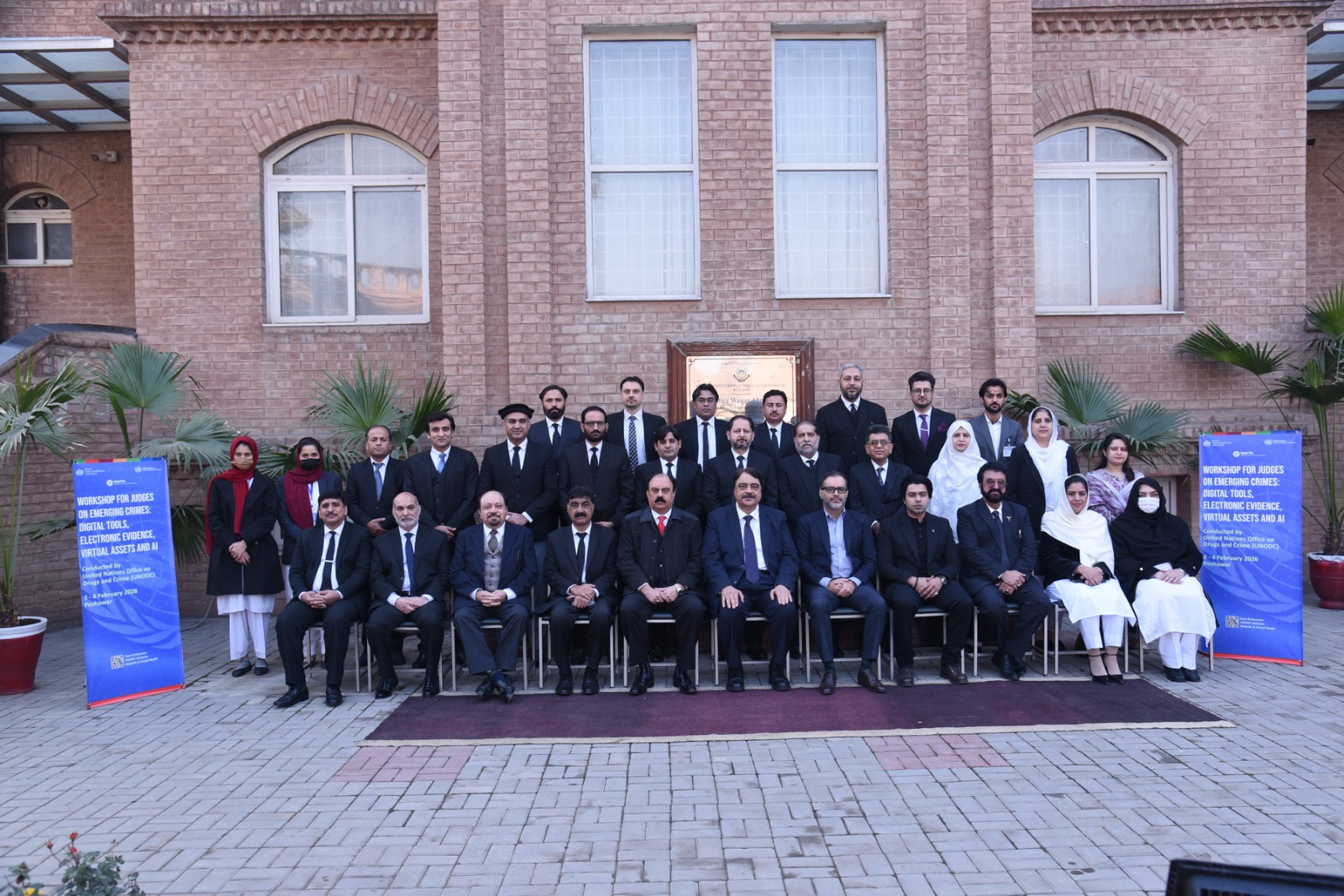
PESHAWAR (February 4, 2026) – The two-day specialized workshop titled "Emerging Crimes: Digital Tools, Electronic Evidence, Virtual Assets and AI" reached its successful conclusion today at the Khyber Pakhtunkhwa (KP) Judicial Academy. Organized in collaboration with the United Nations Office on Drugs and Crime (UNODC) and supported by the British High Commission and NACTA, the training was designed to strengthen the judicial capacity to handle 21st-century criminal challenges.
Inauguration and Day 1: Foundations of Digital Evidence The workshop was inaugurated by Mr. Jehanzeb Shinwari, Director General of the KP Judicial Academy, who welcomed a cohort of 22 judges from across the province. The participants included District and Sessions Judges, Judges of Special Courts, Additional District and Sessions Judges, Senior Civil Judges, and Civil Judges. The opening sessions focused on the shifting landscape of crime, where digital platforms and online financial systems have enabled new typologies like cyber-fraud and organized transnational crime.
The first day's academic sessions featured Barrister Ikhtiar Khan (Chairman KPST), who discussed the jurisdiction of Anti-Terrorism Courts and the expeditious disposal of cases. Umair Nazar (UNODC) provided technical insights into digital forensics and the vital importance of the chain of custody. Furthermore, Farhan Nawazish (UNODC) guided participants on the judicial consideration of open-source intelligence (OSINT) and the legal admissibility of online evidence, followed by a practical session on blockchain analysis and virtual asset investigations.
Day 2: International Cooperation and the AI Frontier The second day focused on global legal frameworks and the emerging threat of Artificial Intelligence. Mr. Shahid Shafique (UNODC) led comprehensive sessions on Pakistan's legal framework for international cooperation, covering Mutual Legal Assistance (MLA) laws and procedures for requesting subscriber, traffic, and content data from international service providers.
The training then pivoted to the risks posed by Generative AI, with M. Aqib Bangash (Intelligence X One) detailing the threat landscape of deepfakes, automated fraud, and disinformation. These sessions aimed to prepare the judiciary for the evidentiary and procedural challenges AI introduces to investigations and courtroom proceedings.
Concluding Ceremony The workshop culminated in a formal ceremony chaired by Mr. Jehanzeb Shinwari, DG KPJA, who conducted a post-training evaluation and distributed certificates to the successful participants. In his closing remarks, the Director General emphasized that such initiatives are crucial for maintaining consistency in jurisprudence and ensuring that the judicial system remains resilient against the rapid evolution of technology-facilitated crimes.
Hashtags: #KPJudicialAcademy #UNODC #DigitalJustice #CyberCrime #JudicialTraining #AIandLaw #BlockchainForensics #LegalInnovation #ElectronicEvidence #Peshawar #KPJudiciary