
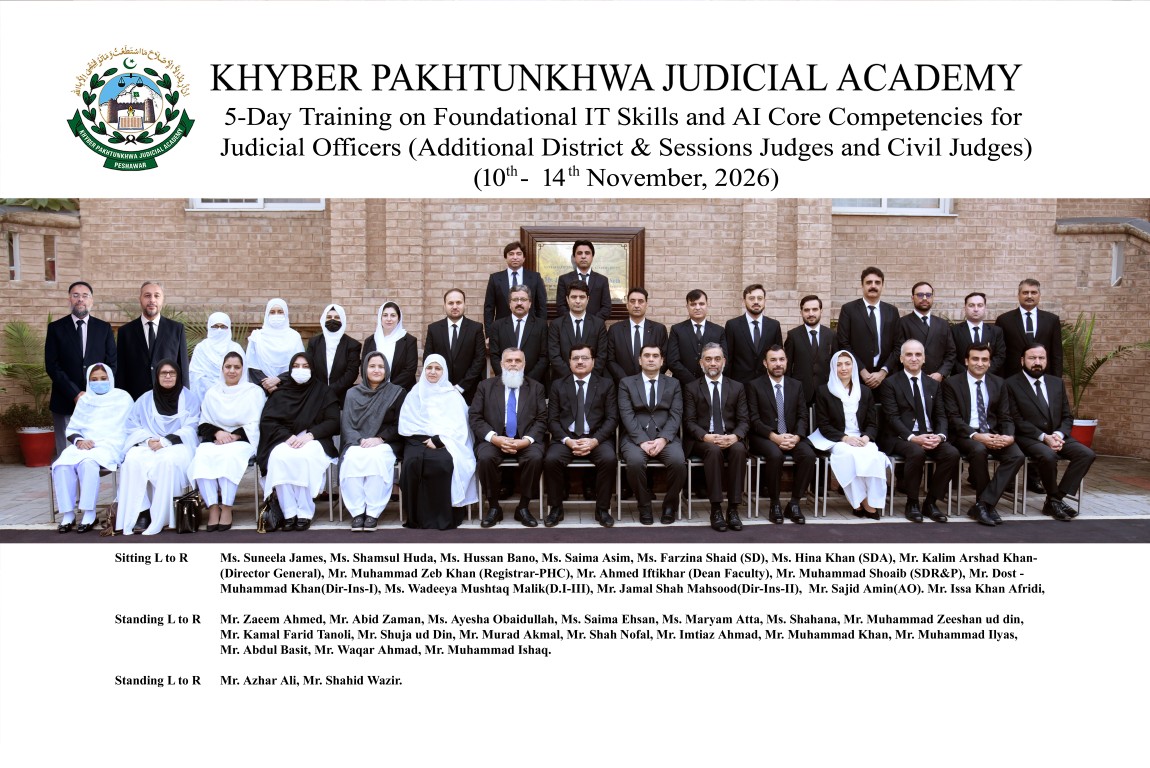
KPJA Concludes Batch-III Training on Foundational IT Skills and AI Core Competencies for Judicial Officers (10-14 November, 2026)
PESHAWAR — The Khyber Pakhtunkhwa Judicial Academy (KPJA), Peshawar, successfully concluded its intensive five-day specialized training program titled "Foundational IT Skills and AI Core Competencies for Judicial Officers" (Batch-III), held from November 10 to 14, 2026. Designed in response to the growing necessity for digital modernization across provincial courts and aligned with the National Guidelines for Use of Artificial Intelligence in Judicial Institutions of Pakistan approved by the National Judicial (Policy Making) Committee (NJPMC), the course equipped participating judges with practical digital tools, ethical prompting frameworks, and automated document processing workflows while strictly reinforcing human oversight and judicial independence.
A total of 23 judicial officers—comprising 10 Additional District & Sessions Judges (Izafi Zilla Qazis) and 13 Civil Judges / Judicial Magistrates (Ilaqa Qazis) representing various districts across Khyber Pakhtunkhwa—successfully completed the rigorous hands-on program and were awarded certificates of completion during the valedictory proceedings.
1. Inaugural Ceremony & Keynote Address: Strategic Vision and Ethical Caveats
The training formally commenced with an inaugural ceremony graced by Mr. Muhammad Zeb Khan, Registrar, Peshawar High Court, who attended as Chief Guest. Addressing the inaugural cohort, the Chief Guest underscored the imperative of technology adoption to streamline court management, expedite case disposal, and reduce procedural backlogs. However, Mr. Muhammad Zeb Khan delivered a critical keynote warning regarding the ethical boundaries of artificial intelligence in judicial decision-making.
The Chief Guest observed that predictive AI algorithms now possess the capability to estimate, with high probability, what verdict a judge is likely to deliver in a given case, effectively reading the judge’s mind before a formal decision is rendered. Warning against this phenomenon, he emphasized that a judge must adjudicate every case independently, guided strictly by its specific facts, evidence, and applicable law with an open mind. He cautioned that if judicial outcomes become predictable in advance, it directly compromises judicial independence, threatens the fairness of trial, and erodes public trust in the administration of justice, calling for clear regulatory rules to address this emerging challenge.
Earlier, Director General KPJA, Mr. Kalim Arshad Khan, presented the welcome address, reaffirming the Academy’s strategic commitment to building institutional digital capacity across the provincial judiciary. All Senior Directors, faculty members, and administrative officers of the Academy were present on the occasion to welcome the Chief Guest and participating officers.
2. Comprehensive 5-Day Modular Curriculum & Laboratory Workflows
The curriculum was structured around a tool-by-tool hands-on methodology delivered on individual lab workstations in the Academy's Main Computer Laboratory. To prevent cognitive overload for participants with varying levels of ICT experience, each day focused on a dedicated software ecosystem, advancing systematically from foundational skills to complex automation.
The following table synthesizes the daily module structure, lead resource persons, core technological platforms, and primary learning deliverables completed by the Batch-III cohort:
| Day & Date | Core Module & Ecosystem | Lead Resource Person | Practical Workflows & Technical Deliverables |
| Day 1 Tue, Nov 10 | AI Foundations & Advanced MS Word | Mr. Ahmed Iftikhar (Dean Faculty KPJA) & Mr. Dost Mohammad Khan (Director Instructions KPJA) | LMS onboarding; course briefing; distinction between Generative, Agentic, and Predictive AI vs search engines; MS Word layout, custom styles, section breaks, headers/footers, automated tables of contents, track changes, inline comments, and document formatting. |
| Day 2 Wed, Nov 11 | ChatGPT Ecosystem & Source-Grounded Analysis | Dr. Arif Shah (Dean Faculty, CUSIT, Peshawar) | Fast vs reasoning model evaluation; privacy controls (model improvement, Temporary Chat, memory management); structured prompting; source-grounded document analysis with exact page citations and quotes; Canvas draft refinement; orders spreadsheet-to-chart data analysis; receipt scanning; voice dictation and read-aloud proofreading; ChatGPT Portfolio completion. |
| Day 3 Thu, Nov 12 | Claude Ecosystem & Multi-File Analysis | Prof. Dr. Awais Adnan (IM Sciences, Peshawar) | Model selection and thinking controls; privacy settings and incognito chat; multi-file version comparison of incident reports; Claude Projects configuration with persistent instructions; Artifact generation (Word/Excel files); visual photo/chart interpretation; claim verification rubrics (verified, corrected, unsupported); comparative rubric scoring across ChatGPT and Claude; Claude Portfolio completion. |
| Day 4 Fri, Nov 13 | Gemini Ecosystem, Offline LLMs & AI Agents | Asst. Prof. Adnan Amin (IM Sciences, Peshawar) | Gemini interface and MS Word integration; speech-to-text dictation via OpenAI Whisper and Omnilingual ASR; local offline LLM deployment using LM Studio and Ollama; Google Workflow environment (Drive, Docs, Sheets, Slides, Gmail); custom Gems; spreadsheet data visualization; reinforcement lab building AI agents (Document Redaction Pipelines, Trial Record Chronology Extractors, Memo Generators with Prompt Caching, Case Law Citation Auditors, and Low-Code RAG via Dify.ai / AnythingLLM). |
| Day 5 Sat, Nov 14 | Ethical AI Adoption & Judicial Guidelines | Mr. Ahmed Iftikhar (Dean Faculty KPJA) | Ethical boundaries, human oversight, transparency, and data privacy mandated by the National AI Guidelines (NJPMC Guidelines 4.1–4.3); formal Moodle LMS Post-Assessment Test; Valedictory Ceremony and certificate conferment. |
Detailed Academic Progression
The academic journey commenced on Day 1 with technical onboarding onto the KPJA Moodle LMS portal, followed by an orientation on assessment criteria delivered by Dean Faculty Mr. Ahmed Iftikhar. In the opening lecture, Mr. Iftikhar established the theoretical framework of artificial intelligence, clarifying how Large Language Models (LLMs) differ from conventional search engines. The afternoon session, led by Director Instructions Mr. Dost Mohammad Khan, focused on advanced Microsoft Word processing. Participating judges executed lab exercises covering section breaks, automated tables of contents, styles, and track changes, mastering the essential word-processing skills required to export and format AI-generated legal drafts into standardized court orders.
On Day 2, Dr. Arif Shah facilitated intensive lab sessions on the ChatGPT platform. Judicial officers explored model selection across fast and reasoning architectures, configured essential privacy settings including model-improvement opt-outs and Temporary Chat, and mastered structured prompting techniques (role, context, task, format). Participants performed source-grounded document analysis on complex legal PDFs, extracting key facts with exact page references and direct quotes while enforcing strict anti-hallucination controls. Judicial officers also refined multi-page drafts section-by-section using Canvas, converted court orders spreadsheets into visual data charts, and completed their mandatory ChatGPT Portfolios featuring explicit verification checklists.
On Day 3, Prof. Dr. Awais Adnan led modules on the Claude ecosystem and multi-file analysis. Judicial officers engaged in practical version comparisons across multiple incident reports, systematically identifying modified dates, altered figures, and textual variations confirmed against original files. Participants configured Claude Projects with persistent instructions for judicial scenarios and created simple and complex Artifacts to generate downloadable Word and Excel files. Working with visual charts and photographs, officers evaluated model outputs against a standardized verification rubric, classifying claims as verified, corrected, or unsupported, and concluded the day by finalizing their Claude Portfolios.
On Day 4, Asst. Prof. Adnan Amin guided participants through the Gemini ecosystem, speech-to-text dictation, and offline model execution. To handle confidential court records securely without internet connectivity, judicial officers installed and executed local offline LLMs using LM Studio and Ollama. Participants executed speech-to-text dictation using OpenAI Whisper and Omnilingual ASR, and analyzed multi-file workflows across Google Drive, Docs, Sheets, and Gmail. In the afternoon reinforcement lab, judges constructed specialized AI agents, including Document Redaction Pipelines, Trial Record Chronology Extractors, Memo Generators with Prompt Caching, Case Law Citation Auditors, and low-code Retrieval-Augmented Generation (RAG) agents using Dify.ai and AnythingLLM.
3. Rigorous Assessment Framework & Moodle LMS Integration
To ensure measurable learning outcomes and maintain academic excellence, the training program was evaluated under the formal KPJA Assessment Policy approved in alignment with Peshawar High Court guidelines. Performance was assessed out of a total of 100 Marks, distributed across theoretical knowledge, practical lab execution, and professional conduct:
- Post-Training Knowledge & Practical Lab Test (70 Marks): Evaluated on Day 5 via the KPJA Moodle LMS portal, comprising 70 items spanning Multiple Choice Questions (MCQs), short-answer analytical questions, structured prompt writing, source verification tasks, and MS Word formatting exercises covering all topics taught during the week.
- Punctuality & Attendance (10 Marks): Assessed through full attendance, strict adherence to session timelines, and prompt arrival for morning and post-break sessions.
- Classroom Conduct & Decorum (10 Marks): Evaluated based on professional courtroom demeanor, adherence to lab guidelines, and active engagement in faculty-led discussions.
- Active Participation & Daily Portfolios (10 Marks): Awarded for the complete submission of daily practical assignments, including the ChatGPT Portfolio, Claude Portfolio, verification checklists, and personal prompt libraries.
4. Valedictory Ceremony: Celebrating Competency and Upholding Judicial Integrity
The five-day program culminated in a formal valedictory ceremony chaired by the Hon’ble Mr. Justice Ijaz Anwar, Senior Puisne Judge, Peshawar High Court / Vice Chairman, KPJA, who graced the occasion as Chief Guest.
Addressing the graduating cohort, the Hon’ble Chief Guest commended the Academy for conducting a timely, highly practical course that directly addresses the operational needs of the judiciary. Justice Ijaz Anwar emphasized that adopting digital technology and artificial intelligence is vital for modernizing judicial administration, improving court management, and expediting the disposal of cases. Crucially, the Chief Guest reiterated that while AI tools provide invaluable administrative and analytical support, they must strictly remain ancillary instruments: human intellect, judicial wisdom, and independent legal reasoning must always govern the determination of justice.
In his concluding remarks, Director General KPJA, Mr. Kalim Arshad Khan, expressed sincere gratitude to the Chief Guest for his patronage and guidance. He congratulated the 24 graduating judicial officers for their dedication and hard work throughout the week, reaffirming the Academy’s strategic vision to continually upgrade its IT infrastructure and roll out advanced technology courses for the provincial judiciary.
During the ceremony, the hon'ble Chief Guest and the learned Director General conferred certificates of completion upon all 24 successful judicial officers. The landmark event concluded with an official group photograph.