
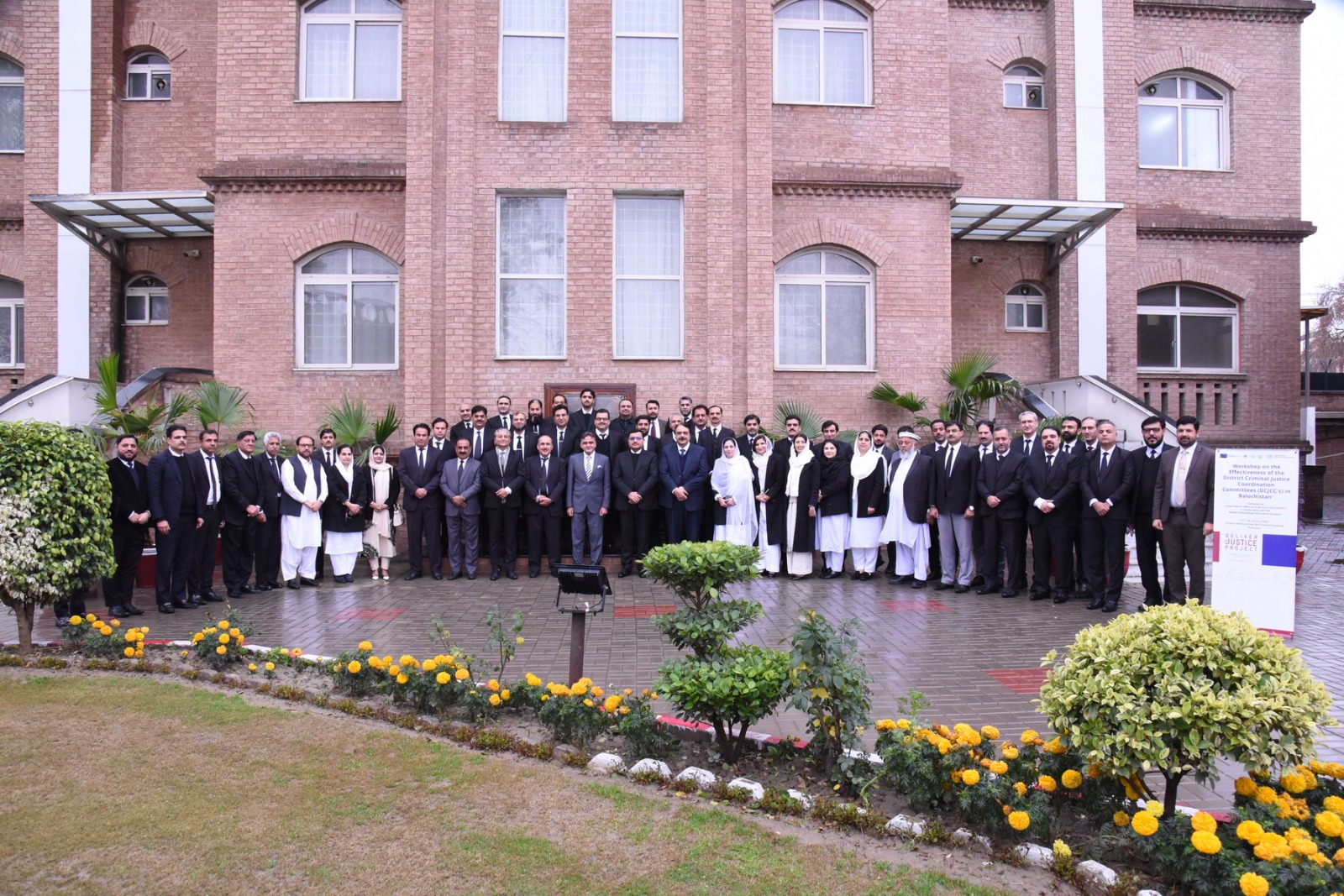
PESHAWAR, January 28, 2026 – In a landmark initiative to enhance the delivery of justice at the district level, the High Court of Balochistan, in collaboration with the Peshawar High Court and the UNODC, successfully concluded a two-day joint workshop on the “Effectiveness of District Criminal Justice Coordination Committees (DCJCCs).”
Held at the Khyber Pakhtunkhwa Judicial Academy (KPJA) from January 27–28, the event was organized under the European Union-funded Deliver Justice Project. It provided a unique platform for cross-provincial learning, bringing together 20 Judicial Officers from Balochistan and 29 Additional District and Sessions Judges from Khyber Pakhtunkhwa.
Inaugural Session: A Display of Institutional Unity
The workshop commenced with a high-level inaugural ceremony jointly graced by Mr. Nasir Khan Yousafzai, Registrar of the High Court of Balochistan, and Mr. Muhammad Zeb Khan, Registrar of the Peshawar High Court.
In his welcome address, Mr. Nasir Khan Yousafzai termed the DCJCCs the "backbone of the district justice system," emphasizing their statutory role in resolving operational bottlenecks between the police, prosecution, prisons, and the judiciary. The Registrar of the Peshawar High Court welcomed the delegates, underscoring the strong fraternal ties between the two provinces and the value of sharing institutional knowledge.
Proceedings: Peer Learning and Expert Mentorship
The two-day technical proceedings were mentored and moderated by Mr. Shahid Shafiq, a senior legal expert and Former District & Sessions Judge (Sindh).
Day 1 focused on "Setting the Context." Participants engaged in a comparative analysis of the justice landscapes in both provinces. Experts from the KP Judicial Academy presented the "KP Model," detailing how their districts have successfully utilized coordination committees to manage prison overcrowding and improve investigation standards.
Day 2 transitioned into "Strategic Action Planning." Mr. Shahid Shafiq guided the participants through intensive group work. The judicial officers were divided into thematic groups to dissect structural challenges and resource constraints. Representatives from each group presented consolidated recommendations, focusing on:
- Standardizing DCJCC meeting agendas.
- Enhancing data-sharing mechanisms between stakeholders.
- Establishing follow-up mechanisms to ensure decisions are implemented.
Conclusion and Way Forward
The workshop concluded on January 28 with a simple yet dignified closing ceremony.
Mr. Ahmed Iftikhar, Dean Faculty of the KP Judicial Academy, commended the participants for their active engagement. He noted that the presence of senior judges from both provinces enriched the discourse, allowing for a pragmatic exchange of solutions.
In his concluding remarks, Registrar Nasir Khan Yousafzai thanked the organizers and the mentor, Mr. Shahid Shafiq. He stated that the "Action Plan" developed during the workshop would serve as a blueprint for revitalizing DCJCCs in Balochistan. He urged the participants to implement these recommendations in their respective districts to ensure swift and inexpensive justice for the public.